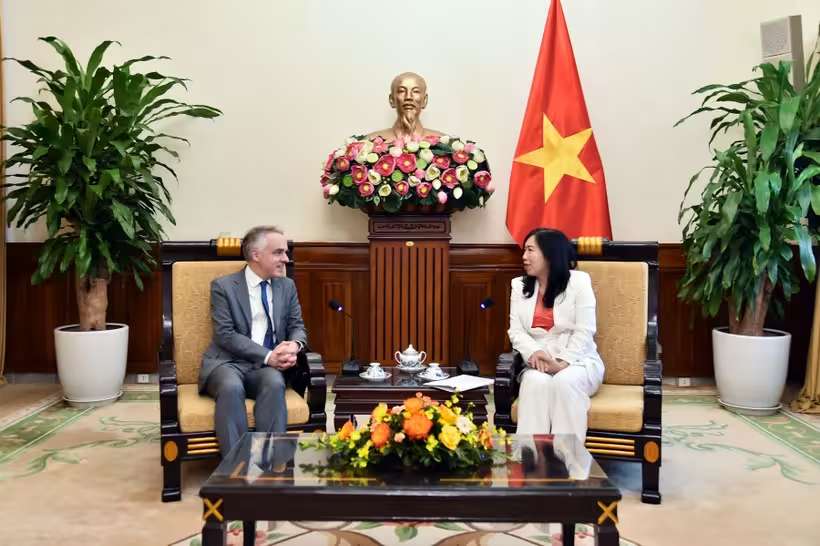
At the opening of the session, Ms. Paola Pampaloni, head of the EU delegation, expressed condolences and shared concerns over the damage caused by storms and floods to the people. She announced that 850,000 Euros have been provided to Vietnam to address the aftermath of recent typhoons and urged EU member states to contribute further support to Vietnam. Several EU member states, including Germany and the Czech Republic, have responded to this call.
On November 24, a plane carrying the EU's emergency aid shipment from Luxembourg arrived in Vietnam.
During the session, both sides updated each other on their socio-economic situations and foreign policies. They conducted a comprehensive review of Vietnam-EU cooperation under existing frameworks, including the Defense-Security Dialogue, the Trade Committee implementing the Vietnam-EU Free Trade Agreement, and specialized subcommittees within the Vietnam-EU Joint Committee.
Both parties were pleased to note that, after 35 years of diplomatic relations, Vietnam-EU relations have positively developed across all fields. Political trust has been continuously strengthened, with increased exchanges and contacts at all levels, especially high-level, and relations with EU member states have been robustly reinforced.
To date, Vietnam has established a Comprehensive Strategic Partnership with France; Strategic Partnerships with Spain, Germany, Italy, the Czech Republic, Finland, and Bulgaria; and a Comprehensive Partnership with Denmark, Hungary, and the Netherlands.
Trade-investment cooperation, development cooperation, defense-security, education-training, and climate change response have seen significant progress. Existing cooperation and dialogue mechanisms have proven effective.
Both sides have worked to implement numerous projects and cooperation programs on public financial modernization, economic governance enhancement, and sustainable energy transition, with the EU providing technical support, capacity building, and experience sharing for Vietnam.
To further enhance bilateral relations in the future, both sides agreed to continue high-level exchanges, fully and effectively implement the Vietnam-EU Free Trade Agreement (EVFTA), and encourage the remaining 6 out of 27 EU member states to soon ratify the Vietnam-EU Investment Protection Agreement (EVIPA). They also aim to maximize the effectiveness of existing cooperation and dialogue mechanisms.
Both parties agreed to broaden and deepen cooperation in all potential fields, particularly trade-investment, development cooperation, green economy, digital transformation, circular economy, modern and sustainable fisheries development, clean energy transition, innovation, infrastructure, climate change response, and biodiversity conservation.
They emphasized strengthening cooperation in science-technology and innovation, considering it a new and important pillar in collaboration. This leverages the EU's strengths and meets Vietnam's needs in the new era.
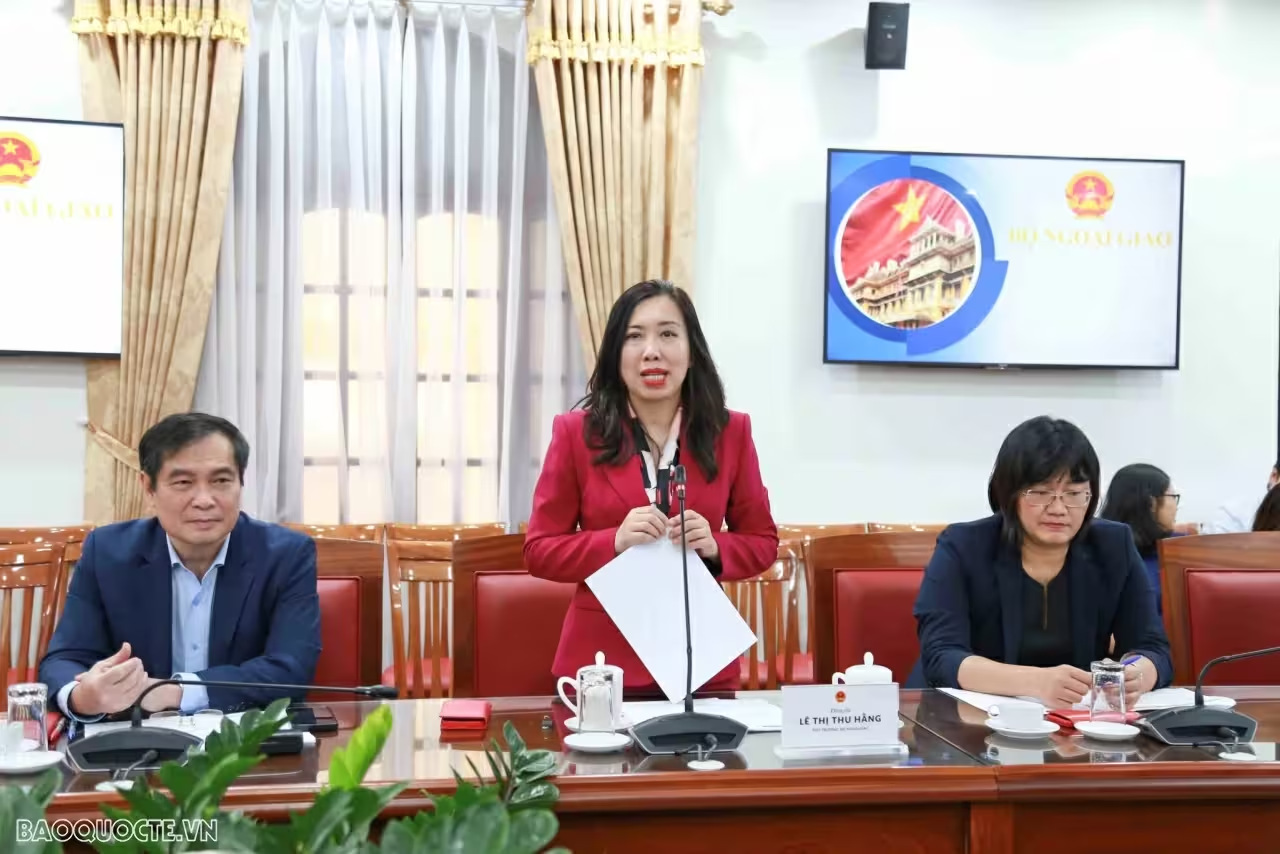
Deputy Foreign Minister Le Thi Thu Hang highlighted the importance of enhancing cooperation in potential key areas such as science-technology, marine economy, energy transition, education-training, environmental protection, and sustainable development. She also proposed effectively utilizing EU initiatives like Erasmus (Education, Training, Youth, and Sports Program), Horizon Europe (EU's largest research and innovation program), and JETP (Just Energy Transition Partnership).
The Deputy Minister also informed the EU about Vietnam's serious and decisive measures in combating and handling illegal, unreported, and unregulated (IUU) fishing violations. She requested the EU and member states support the early removal of the "yellow card" on Vietnamese seafood. The EU acknowledged Vietnam's efforts and will consider discussing some technical issues with Vietnam.
Representatives from various ministries and sectors attending the session proposed specific measures to enhance bilateral cooperation in trade-investment, finance, development cooperation, climate change response, agriculture, defense-security, and more.
The EU affirmed that Vietnam is an important partner and a model in the Asia-Pacific region, committed to continuing support for Vietnam's sustainable development. The EU highly appreciates Vietnam's impressive achievements in socio-economic development and international integration, considering Vietnam a model partner in ASEAN and ready to accompany in implementing strategic goals, especially in science-technology and energy transition in the new development era.
Agreeing with Vietnam's proposals, the EU announced priorities in its Indo-Pacific Cooperation Strategy and Global Gateway Initiative, expressing a desire for Vietnam to actively participate in cooperation projects within these strategies.
Discussing international and regional issues of mutual concern, both sides agreed to promote multilateralism and the role of the United Nations. They affirmed that disputes must be resolved peacefully, based on international law and the fundamental principles of the UN Charter, ensuring security, safety, and freedom of navigation and aviation in the East Sea in compliance with international law, particularly the United Nations Convention on the Law of the Sea 1982 (UNCLOS 1982).
Both sides agreed to support strengthening the ASEAN-EU Strategic Partnership, prioritizing the promotion of trade-investment cooperation, addressing global challenges on climate, environment, natural disasters, and diseases, contributing to green and sustainable development, and sub-regional development cooperation, including the Mekong sub-region./.