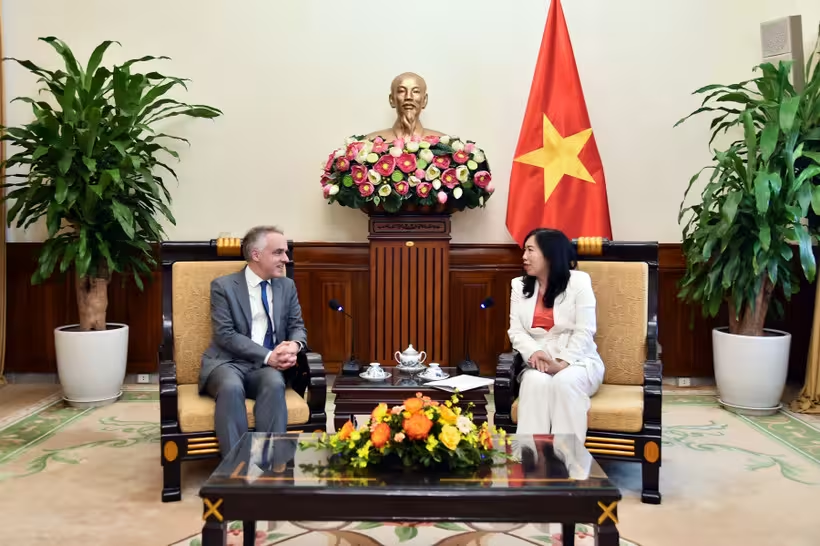
From the initial steps to establish relations in 1990, the EU has gradually become one of Vietnam's key development partners in its process of Renewal, opening up, and international integration, with numerous programs supporting socio-economic development, institutional capacity building, human resource training, and improvements in infrastructure and healthcare.
Over time, the Vietnam-EU relationship has been nurtured and elevated, becoming one of the most dynamic and profound relationships between the EU and an ASEAN country, making Vietnam the nation with the most cooperation mechanisms with the EU in ASEAN.
The signing of the Partnership and Cooperation Agreement (PCA) in 2012, the EU-Vietnam Free Trade Agreement (EVFTA) in 2019, along with numerous other important agreements in security-defense, investment, agriculture-forestry-fisheries, have led to increasingly effective and comprehensive bilateral relations based on political trust, open dialogue, shared interests, and overcoming differences.
In recent years, political-diplomatic cooperation has seen significant milestones with frequent exchanges of delegations and high-level contacts, coordination of positions at international and regional forums. This year, the President of the European Council held a phone call and congratulated General Secretary To Lam on the occasion of Vietnam's 50th anniversary of the Liberation of the South and National Reunification (April 30, 2025). Prime Minister Pham Minh Chinh held bilateral meetings with the President of the European Commission and the President of the European Council at multilateral summits, along with numerous delegation exchanges at various levels and fields.
In a world of many changes, Vietnam and the EU continue to maintain a common voice on respecting international law, ensuring maritime security and safety, and supporting multilateralism. Close coordination between the two sides within the framework of the United Nations, ASEAN-EU, and strategic dialogues, security-development cooperation, parliamentary exchanges, has created a network of mutual trust, contributing to shared responsibilities for peace, stability, and development in the Indo-Pacific region.
One of the highlights in Vietnam-EU relations is trade and investment cooperation. After five years of implementation, the EVFTA has led to remarkable growth in bilateral trade. Despite complex global economic fluctuations, bilateral trade turnover in 2024 still grew positively by over 10% ($68.4 billion), and increased by 8.4% ($54.6 billion) in the first nine months of 2025.
The EU is currently Vietnam's fourth-largest trading partner and sixth-largest investor, while Vietnam is the EU's largest trading partner in ASEAN. The EU is Vietnam's third-largest export market, where Vietnamese exports - from coffee, cashews, seafood to electronics, textiles - are increasingly favored by EU consumers.
Conversely, European businesses have been present in Vietnam since its opening and have established a strong foothold in the country for decades. Thousands of EU investment projects operate effectively across Vietnam, and the EU business community continues to expand its investment scale, viewing Vietnam as an attractive market thanks to its stable politics, improved business environment, high-quality workforce, and strategic location, making it a promising destination for green and high-tech capital flows.
In the field of development cooperation and sustainable development, the EU is a crucial development aid provider for Vietnam, offering valuable support in programs and projects related to judicial reform, education system development, forestry, environment, and climate change and disaster response.
With the EU and its member states' support, Vietnam has become a model for implementing the United Nations' Sustainable Development Goals (SDGs) and Millennium Development Goals (MDGs). In the remotest areas, EU-supported projects have transformed many villages and hamlets. Through the Just Energy Transition Partnership (JETP) between Vietnam and the International Partners Group (IPG), climate support programs, circular economy, and green agriculture, the EU is becoming a reliable partner and companion to Vietnam in its journey to achieve net-zero emissions for a green and sustainable future.
Vietnam and the EU are also important partners in security and defense with the Framework Participation Agreement (FPA) signed in 2019, establishing Vietnam's participation in EU crisis management operations, and the defense-security dialogue mechanism, affirming both sides' commitment to contributing more to global peacekeeping and security efforts. The two sides also closely coordinate in addressing non-traditional security challenges such as search and rescue, combating transnational crime, cybercrime, human trafficking, and counter-terrorism, achieving many positive results.
Bilateral cooperation in other areas such as education - training, science - technology, innovation, culture is also being strengthened and expanded. Through programs like Erasmus , Horizon Europe, Team Europe, and many research and education cooperation programs, the two sides have regularly exchanged students, lecturers, academic exchanges, and implemented joint research projects. Cultural activities, art exhibitions, film weeks are regularly organized, enhancing understanding and deepening friendship and cooperation between Vietnam and EU countries.
Moreover, other areas such as justice, agriculture, forestry, and sustainable fisheries have been further promoted and dialogue intensified to remove barriers and facilitate bilateral cooperation.
Looking to the next 35 years and beyond, with a solid foundation and shared vision, along with the orientation to upgrade relations to a comprehensive strategic partnership soon, there is confidence in a journey of growth for Vietnam-EU relations with broader cooperation space and increasingly high and sustainable quality.
In a world of many changes, Vietnam and the EU share many similarities, including sustainable values, support for multilateralism, peace-building, and eliminating the risks of armed violence and local conflicts to leverage comprehensive development advantages.
The shared vision of both sides for a peaceful, secure, safe, and prosperous world and Indo-Pacific region, along with values of respecting international law, including UNCLOS 1982, supporting free trade and sustainable development, will drive Vietnam-EU cooperation to a deeper strategic level, especially in enhancing political trust, high-level delegation exchanges, promoting cooperation in maritime security, cybersecurity, UN peacekeeping activities, and cooperation in international and regional mechanisms such as the United Nations, ASEAN-EU Strategic Partnership framework, Inter-Parliamentary Union (IPU)...
With current global development trends, Vietnam-EU cooperation faces wide-open doors in areas like circular economy, renewable energy, semiconductors, satellites, and digital transformation. The EU is promoting a strategy to diversify supply chains and markets, while Vietnam, with its strategic location, young workforce, and improving business environment, has the potential to become a top attraction for EU businesses. The EVIPA, once ratified, will boost high-quality EU investment in areas where the EU has strengths and Vietnam has needs, such as renewable energy, transport infrastructure, smart cities, circular economy, biotechnology, healthcare, and pharmaceuticals.
Green transition and sustainable development - EU's strengths - are predicted to be prominent cooperation areas in the coming period as the EU continues to commit to accompanying Vietnam in its energy transition process, aiming for net-zero emissions by 2050.
Although challenging, the EU's sustainable standards on environmental responsibility, origin traceability, combating illegal fishing, and deforestation will also be opportunities for Vietnam to enhance cooperation with the EU on policy dialogue, technical-financial support, helping Vietnam raise production standards, deep processing, and transition to sustainable industries. Additionally, there is significant potential for cooperation in emerging industries such as quantum, AI, semiconductors, technology transfer, satellites, and cloud computing.
Cooperation in education, culture, and arts, and people-to-people exchanges will continue to nurture friendship and trust between the two sides. Vietnam will remain a favorite destination for EU tourists thanks to Vietnam's favorable visa policies, while the EU will continue to be a cultural and educational cradle that many Vietnamese students aspire to.
In the 35-year journey of Vietnam-EU diplomatic relations full of remarkable achievements, the guidance and nurturing of generations of leaders and the persistent efforts of ministries, sectors, and localities, especially the significant contributions of the business community and the Vietnamese community in Europe and the European community in Vietnam - the vibrant "people's ambassadors" - have contributed to strengthening the ever-closer friendship between the two sides, making Vietnam-EU relations a "model and success story of equal, peaceful, and developmental cooperation" as noted by European Council President Antonio Costa.
With that spirit, stepping into the era of national growth, Vietnam wishes to continue accompanying the EU to elevate the cooperation between Vietnam and the EU and its member states to a new height, meeting the interests of both sides, becoming one of the model relationships between Asia and Europe, and together creating a future of peace, prosperity, and sustainability in both regions and the world./.